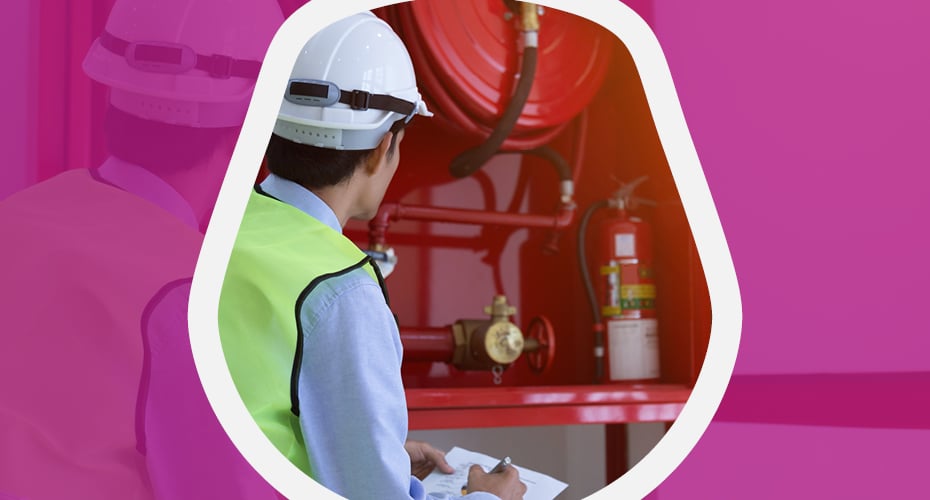

Nobody pulls a fire risk assessment out of the filing cabinet on a good day. It comes out when the insurer asks for evidence, when a fire officer visits, or when something changes on site and the person responsible needs to know whether the document still holds up. If you manage compliance across a commercial property, that question, whether the assessment is still valid, tends to arrive at exactly the wrong moment. We carry out fire risk assessments across commercial premises every week and see the same questions come up on almost every call.
How Long Is a Commercial Fire Risk Assessment Valid For?
There is no fixed statutory expiry date. The Regulatory Reform (Fire Safety) Order 2005 does not set a specific validity period for a fire risk assessment. Instead, it places a duty on the responsible person to keep the assessment under review and to revise it when it is no longer considered valid.
In practice, we recommend that fire risk assessments are reviewed once a year. An annual review keeps the document aligned with the current state of the building, the occupants, and the activities happening inside it. If the building has not changed and no significant events have occurred, the review confirms that the existing assessment still reflects reality. If something has changed, the review picks it up.
The Fire Safety Act 2021 amended the RRFSO to clarify duties around the external walls and flat entrance doors of multi-occupied residential buildings, but for commercial premises the core duty remains the same: the assessment must be kept current and reflect the building as it is, not as it was when the assessment was first written.
When Should a Fire Risk Assessment Be Reviewed?
The annual review is the standard cycle. Alongside that, a review should be triggered whenever there is reason to believe the assessment is no longer valid, or where a significant change has taken place to the premises, the activities carried out there, or the people using the building.
Higher-risk environments, such as those storing flammable materials, running industrial processes, or housing large numbers of people, may need reviewing more frequently than once a year. Your assessor can advise on the right cycle for your specific site.
The key word in the legislation is “significant.” A single desk moving across an open-plan office does not invalidate your assessment. A full floor being repurposed from storage to occupied workspace does.
Under What Circumstances Should a Fire Risk Assessment Be Reviewed?
Beyond the annual cycle, specific changes on site should trigger a review. A fire risk assessment becomes out of date when the building, the people in it, or the activities carried out there no longer match what is described in the document.
Practical triggers include:
- Building alterations, extensions, or layout changes that affect escape routes, compartmentation, or fire door positions
- New plant, equipment, or processes that introduce or change fire hazards
- A significant increase or decrease in occupancy numbers
- The introduction of vulnerable occupants who may need assisted evacuation
- A change of use for the building or part of it
- A near-miss or actual fire incident on site
- Changes in relevant fire safety legislation or guidance
- Fire safety equipment being replaced, removed, or upgraded
If any of these have happened since the last review, the existing assessment may no longer reflect the real risk profile of the building. A review at that point is not optional; it is what the legislation requires.
Do Insurers Accept an Out-of-Date Fire Risk Assessment?
Most commercial insurance policies include a condition requiring a current, reviewed fire risk assessment to be in place. The specifics vary between insurers, but the principle is consistent: if the assessment is out of date and a fire occurs, the insurer may challenge or reduce the claim on the basis that the policyholder was not meeting their fire safety obligations.
This is not about scare tactics. It is about the practical reality of how insurance claims are assessed. An insurer reviewing a claim after a fire will look at the date of the last fire risk assessment, whether it was reviewed in line with the recommended cycle, and whether any known changes to the premises were reflected in the document. A current, reviewed assessment gives you a much stronger position.
If your insurer or auditor has asked for evidence of a current commercial fire risk assessment, that is usually the signal that a review is due.
Who Is Responsible for Reviewing a Commercial Fire Risk Assessment?
The duty sits with the ‘responsible person’, as defined under the Regulatory Reform (Fire Safety) Order 2005. In commercial premises, this is typically the building owner or the employer. For leased or rented commercial property, the landlord usually holds the duty, though this can depend on the terms of the lease.
The responsible person does not have to carry out the review themselves, but they must appoint a competent person to do it. “Competent” means someone with the right training, qualifications, and experience to assess the fire risks specific to the building.
If you are the responsible person for a commercial site, keeping track of when the assessment is due for review is part of the duty. We track review schedules for our clients and send reminders when a review is coming up, so nothing slips through the gap.
Book Your Fire Risk Assessment Review With Hawkesworth
We carry out annual reviews and full reassessments across commercial premises of all sizes, from single offices to multi-site portfolios across the UK and Ireland. Our 200+ accredited, DBS-checked engineers handle the assessment, flag any changes that need addressing, and update the documentation so your compliance trail stays current, with out-of-hours and weekend availability at no extra charge.
We also track your review schedule and remind you when the next one is due, so the assessment never quietly expires in a drawer.
Request a quote and we will get back to you.

Michael Kiddle
Managing Director of Hawkesworth and a nationally recognised leader in electrical and fire safety, Michael (GIFireE) directs one of the UK's leading compliance companies, safeguarding thousands of businesses each year. Through his voluntary Safe Home Initiative, he has identified and removed thousands of dangerous household appliances from vulnerable people's homes, replacing each one with a safe alternative free of charge.